
Twinkle, Twinkle Little Sat
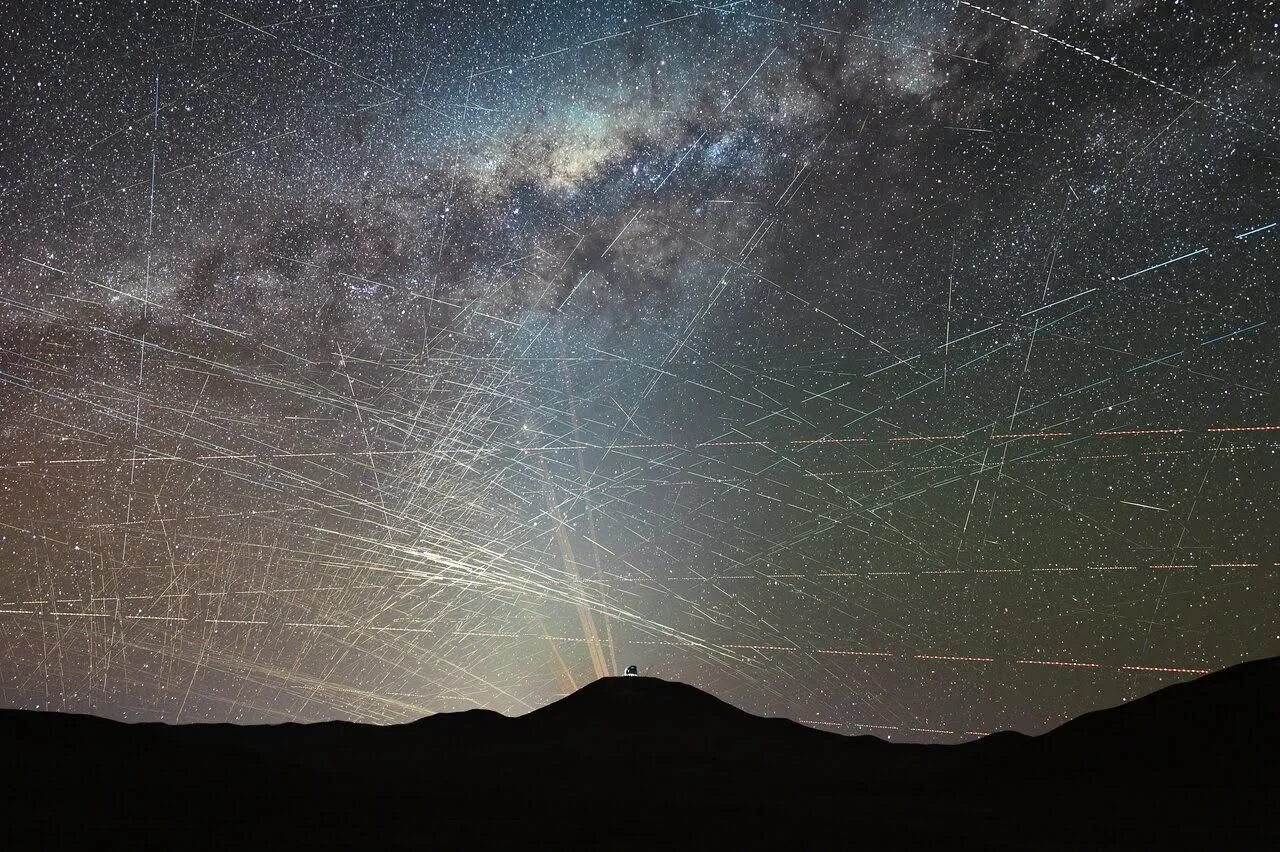
One hour time lapse of plane and satellite trails above the European Southern Observatory. (Image Credit: F. Kamphues, ESO/M. Kornmesser)
By Julie Sacco - DarkSky Chi Advocate
It started in 1962 with the launch of Telstar I from Cape Canaveral. That first communications satellite was 34” wide (about the size of a beach ball) and weighed 170 lbs. Today, a Starlink satellite can weigh up to 1,750 lbs. with a solar panel wingspan of nearly 100 ft. Telstar was the first commercial payload in space. It was a cooperative effort between AT&T’s Bell Laboratories and NASA to “demonstrate the United States’ willingness to share its civilian space efforts with the public” for “the good of all humankind.”
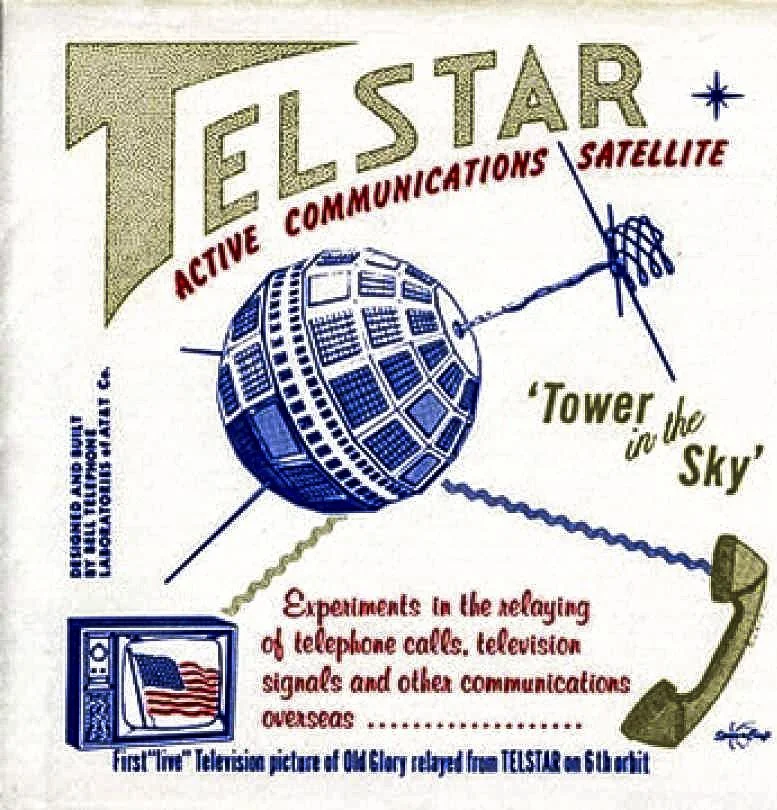
Telstar I, the first commercial communications satellite, launched in1962 (image: NASA)
Dozens of companies now build rockets, and hundreds of operators (owners) own the hardware in orbit. But only a small group of operators dominate the count, starting with SpaceX (Space Exploration Technologies Corporation) which accounts for more than half of all active satellites. Starlink Services is a telecommunications subsidiary of SpaceX and has sent some 13,000 satellites into space since 2019.
Most satellites provide broadband internet service, with the remainder being used for astronomical observations, meteorology, high resolution Earth imaging, maritime and aviation data, and geospatial intelligence. While SpaceX currently leads global launches via its reusable Falcon 9 rockets, Blue Origin is not far behind as it develops heavy-lift capabilities to support commercial “constellations.”
A satellite constellation is comprised of hundreds or even thousands of satellites operating in coordinated orbital planes to provide continuous global service. They begin as part of a batch deployment of dozens of identical spacecrafts that are released from one launch vehicle into the same orbit; this is called a “satellite train.” Before rising in orbit, an operator on Earth fans out one line of satellites across an entire plane. These trains are bright and tightly packed, producing what we see below as “a string of pearls.”
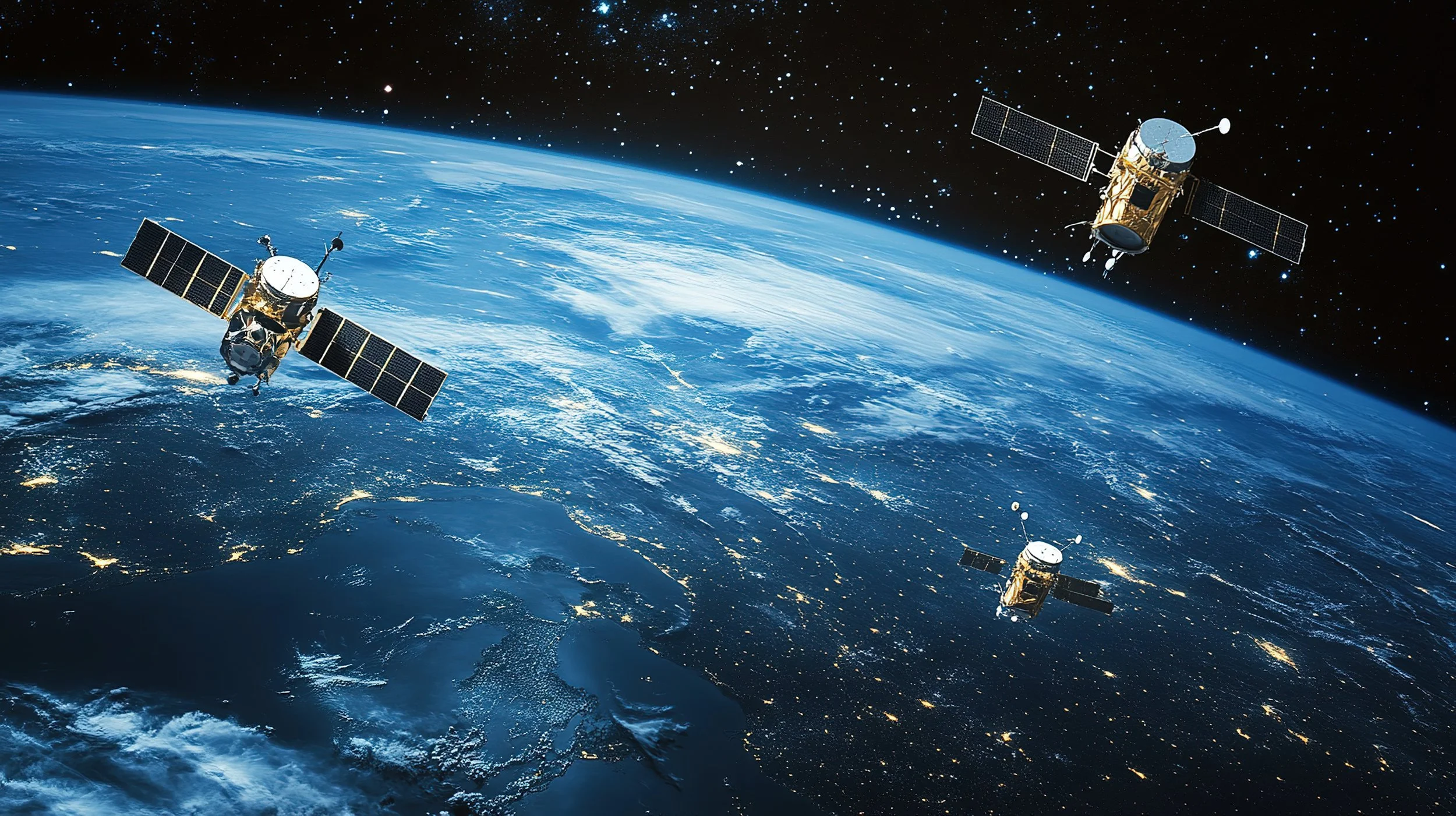
Communications satellites in orbit (image: Adobe stock)
Why are there so many of them? The United States does not have a cap on the maximum number of satellites allowed in a commercial constellation. There are 18,697 active satellites now in Low Earth Orbit (LEO). LEO ranges from 100-1,200 miles above earth. Not long ago, Geostationary (GEO) orbits were the only way to achieve telecommunications.
The main difference between GEO and LEO orbits is the high speed at which communications can now happen at scale. GEO satellites, which orbit at 22,200 miles above Earth’s equator, cannot reach remote, rural or oceanic regions efficiently or affordably with their signals. By comparison, LEO constellations reduce the distance that data needs to travel and, therefore, the time (or latency) involved. Latency is slashed from GEO’s 600-700 millisecond round-trip signal delay to LEO’s 24-40 milliseconds.
Got space junk? These artificial mega-constellations are also changing the orbital environment. Today there are more than 141 million pieces of flight debris in orbit, everything from large detached parts to metal shards to tiny fragments of paint flecks. This matters because debris travels around the globe at 17,500 mph, which means that even a tiny paint fleck can crack a spacecraft window or puncture a solar panel. Today, 96% of orbital debris originates from the United States, Russia and China, with each country accounting for a third.
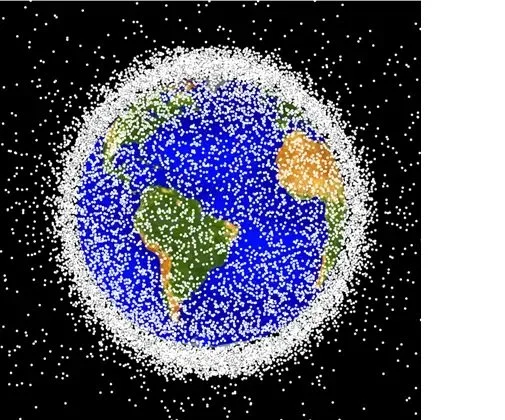
Orbital debris (image: NASA)
Night sky lights. Since the 1990s, astronomers and amateur stargazers alike have raised concerns about the proliferation of satellites in space. These objects are high enough above the Earth to reflect the sun’s light, just as distant planets do. They interfere with ground-based astronomical observations by creating bright streaks on long-exposure telescope images which can permanently erase data from underlying cosmic sources. Thousands of satellites scatter light and raise the overall ambient brightness of the night sky, reducing the contrast needed to detect faint distant galaxies. They also cause electromagnetic interference with radio telescopes by leaking signals that can overwhelm and distort scientific measurements.
Mirror, mirror in the sky. The U.S. Federal Communications Commission’s Space Bureau has just approved a “space mirror” test. Despite formal objections by DarkSky International, the American Bird Conservancy, Environment America, and Earthjustice, the Reflect Orbital company will be allowed to reflect sunlight to Earth at night. The purpose would be to provide light at night for sporting events, to replace streetlights, and to extend industrial and/or agricultural working hours. Reflect Orbital plans to seek approval for up to 50,000 such mirrors by 2035. You can learn more at bit.ly/4fLRthj
Are satellite mega-constellations necessary? Not for basic human survival, but they are needed for high speed, low latency global internet, secure communications and AI. They provide connectivity and cut transmission delays needed for real-time voice, video and financial transactions. However, these advantages go hand-in-hand with the risks of environmental damage from re-entering satellites, space debris aloft, astronomical interference on the Earth, and additional light pollution obscuring the night sky.
Astronomers, scientists and dark sky advocates are actively working with satellite companies to protect the night sky. This involves engineering collaborations, policy agreements, and public advocacy campaigns. Some problems being addressed are reentries, false asteroid alarms, and even stopping development of “obtrusive space advertising” where satellites in orbit display ads that can be seen from the ground. The National Science Foundation and the International Astronomical Union worked with SpaceX to launch “DarkSat” in 2020 which used an experimental black anti-reflective coating to lower its visual magnitude by half. Bipartisan legislation about satellite policy was introduced in the Senate in 2025 but was not passed; plans are for the bill to be revised and reintroduced.
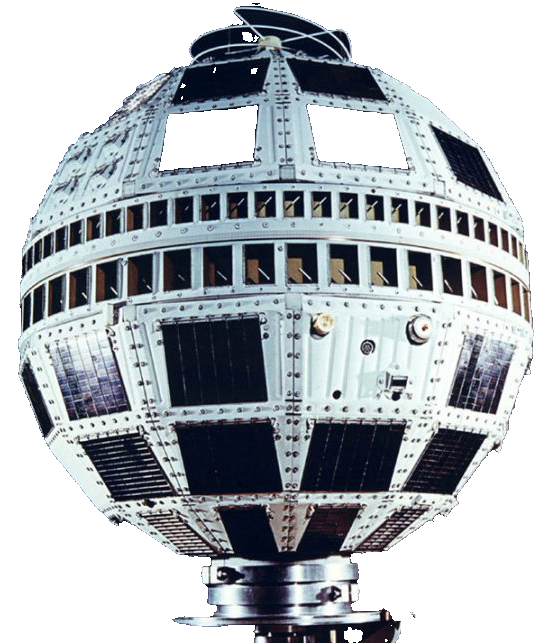
Telstar I (image: NASA)
So, whatever happened to Telstar I? It remained active for 7 months before prematurely failing because of a high-altitude nuclear test conducted by the United States in 1963. Although the first communications satellite is no longer operational, it remains in Earth orbit, just like millions of other pieces of space junk.